
Table of Contents
The Additional Minerals Reporting Template (AMRT) is a free, standardized due-diligence tool developed by the Responsible Minerals Initiative (RMI) to help companies collect sourcing and risk data on minerals beyond:
- Conflict minerals (3TG: tin, tantalum, tungsten, gold)
- Extended minerals (cobalt and mica)
AMRT is designed to close a growing visibility gap in modern supply chains—where ESG expectations, investor scrutiny, and emerging regulations now extend far beyond traditional conflict-minerals reporting.
From Pilot to Standard: How AMRT Evolved
AMRT was originally introduced as the Pilot Reporting Template (PRT), allowing companies to test structured reporting for additional minerals not yet covered by regulation.
That pilot phase is now over.
The tool has matured into AMRT v1.3, released on October 17, 2025, confirming AMRT as a stable, RMI-maintained reporting standard rather than an experimental framework.
Key maturity signals in v1.3 include:
- Refined supplier instructions
- Improved internal validation logic
- Continued multilingual usability (including German)
- Clearer alignment with downstream ESG and regulatory expectations
AMRT is no longer “early-stage.” It is now a long-term due-diligence mechanism.
What Makes the AMRT Unique
AMRT is intentionally flexible—but not unstructured.
Core Characteristics
- Tracks up to 10 user-selected minerals per AMRT submission
- Mineral scope is company-defined, based on risk exposure and material relevance
- Complements—but does not replace— existing reporting templates
- Focuses on risk identification and transparency, not certification
What AMRT Is Not
- Not a legal safe harbor
- Not a smelter audit or certification
- Not a replacement for CMRT or EMRT
Its role is visibility first, not compliance theater.
AMRT vs CMRT vs EMRT: Clear Separation of Purpose
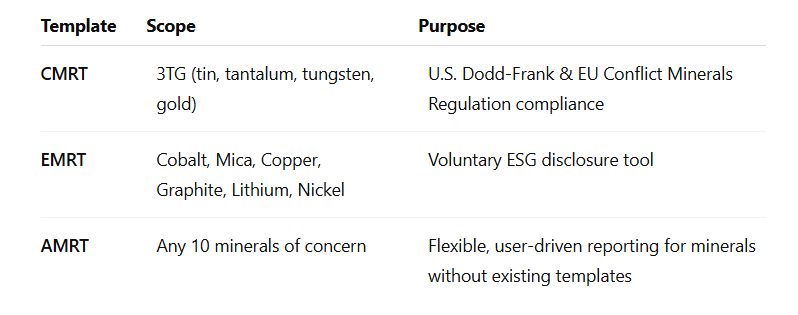
If cobalt or mica appear in AMRT, it is typically for contextual risk mapping only. EMRT remains the authoritative template for those minerals.
Related reading:
Key Challenges in AMRT Adoption
Despite its maturity, AMRT adoption still presents real-world friction:
- Low supplier awareness outside regulated minerals
- Inconsistent validation and poor supplier training
- Incomplete or inaccurate submissions
- No explicit regulation mandating AMRT, creating uncertainty
This last point matters: While AMRT itself is not mandated, the minerals it covers increasingly are—through adjacent regulations and ESG disclosure regimes.
Proven Solutions for Effective AMRT Implementation
High-performing companies treat AMRT as a risk-screening system, not a reporting checkbox.
Best practices include:
- Supplier education via targeted guidance and training
- Automated collection to manage scale and version control
- Early validation to catch gaps before audit or disclosure deadlines
- Risk-based follow-ups, not blanket escalation
- Selective disclosure, aligned with sustainability and ESG reporting
AMRT data is often used internally first, then selectively disclosed—unlike CMRT, where public disclosure is already normalized.
Applications of AMRT in Supply Chains
AMRT supports:
- Due diligence on non-3TG / non-cobalt / non-mica minerals
- CAHRA (Conflict-Affected and High-Risk Areas) screening
- Mineral-level sourcing risk mapping
- ESG-aligned disclosure and stakeholder reporting
As AMRT data accumulates across RMI member companies, it also enables:
- Development of future smelter/refiner reference lists
- Identification of pinch-point minerals in global supply chains
- Input into future regulatory scope expansion and assurance programs
Smelter coverage for many additional minerals remains immature—but AMRT is how those gaps are first identified.
Why AMRT Matters for ESG & Regulatory Readiness
Extended and additional minerals are now firmly on the regulatory radar:
- The EU Battery Regulation targets lithium, cobalt, nickel, and graphite
- CSRD and CSDDD require demonstrable supply-chain due diligence
- U.S. policy signals point toward expanded mineral traceability
- Investors increasingly demand evidence, not intent
AMRT allows companies to demonstrate proactive risk identification, rather than reactive compliance once mandates arrive.
Simplify AMRT Reporting with Acquis
Acquis helps companies operationalize AMRT at scale:
- AMRT-ready supplier surveys
- Campaign-based supplier outreach
- Built-in validation dashboards
- Mineral-level risk visibility
- Continuous regulatory and smelter intelligence
Book a demo to streamline additional-minerals due diligence.
Final Takeaway
Responsible sourcing is no longer defined by minimum compliance.
AMRT exists for companies that want visibility before regulation, structure before crisis, and credibility before scrutiny.
AMRT doesn’t make your supply chain perfect. It makes it visible.