
Table of Contents
For more than a decade, EU RoHS lead exemptions operated in a grey zone.
- They existed.
- They were widely used.
- And most teams assumed they would simply roll forward again.
That assumption is no longer valid.
In late 2025, the European Commission fundamentally changed how lead exemptions under EU RoHS work, not by banning lead overnight, but by putting every major exemption on a clock.
This page explains:
- what changed,
- which exemptions are affected,
- the exact expiry timelines,
- and how manufacturers should operationalize compliance.
If your products contain lead anywhere in the bill of materials — directly or upstream — this page is now part of your compliance baseline.
EU RoHS Regulatory Update, Lead Exemptions (Annex III)
Regulation: EU RoHS Directive 2011/65/EU Annex affected: Annex III (Exemptions)
Legal status
The European Commission:
- adopted revised lead exemptions on 8 September 2025,
- published them in the Official Journal on 21 November 2025, and
- made them legally applicable from 11 December 2025.
From this date forward, legacy exemption language is no longer sufficient for compliance.
What changed structurally
- Long-standing exemptions were split into material- and function-specific sub-entries
- Each sub-entry now carries a fixed expiry date
- Rolling renewals and “pending” exemptions are no longer the norm
Exemptions now behave like temporary design allowances, not permanent safeguards — which is why many manufacturers are shifting from document-based RoHS tracking to system-based exemption management through tools like the Acquis EU RoHS Compliance Module
Understanding Series 6: Lead in Metals
Series 6 covers lead used in:
- steel
- aluminium
- copper alloys
Historically, this was the most relied-upon RoHS exemption group. It is now one of the most time-sensitive.
Series 6 expiry overview
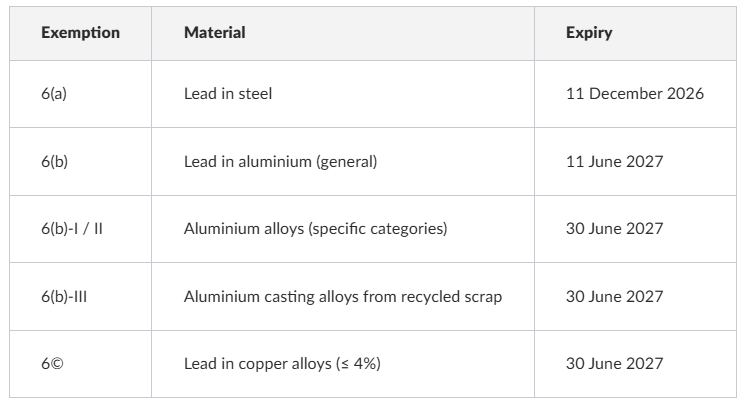
Why Series 6 is now a design risk
- Steel exemptions expire first
- Aluminium exemptions now require precise sub-entry classification
- Copper alloys often sit deep in tier-2 and tier-3 supply chains, where visibility is weakest
This is why leading teams are mapping exemptions directly at the component and material level inside their RoHS programs, not just collecting declarations.
See how this works in practice:
7(a): High-Melting-Point Solder (HMP)
7(a) was once treated as a blanket exemption:
“More than 85% lead = exempt.”
That interpretation no longer holds.
Current structure and expiry
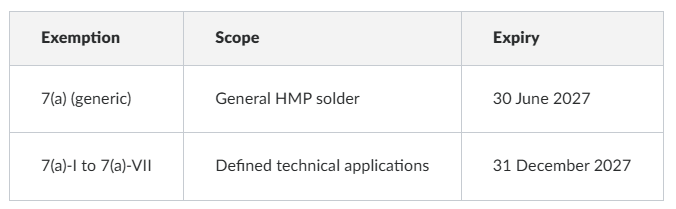
Why justification now matters more than material
After 2027, compliance depends on functional justification, not lead percentage.
Manufacturers must demonstrate why HMP solder is used, such as:
- internal chip-level connections
- die-attach with defined thermal thresholds
- first-stage and second-stage interconnects
- hermetic sealing
- high-temperature lamp or audio applications
This justification must be documented in line with IEC 63000 — not as narrative text, but as structured technical evidence.
Many companies are now embedding this directly into their IEC 63000 technical documentation workflows
7(c): Lead in Glass and Ceramics
7(c) was historically broad and loosely applied. It has now been restructured by technical function.
Current structure and expiry
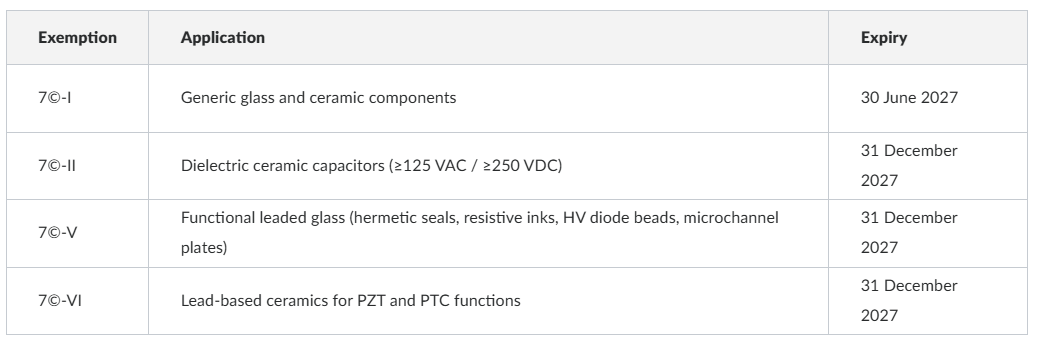
The message is consistent: some applications still require lead — but none are open-ended.
This makes expiry tracking and functional mapping a core compliance task, not a periodic review.
What This Means for Manufacturers (Operational Reality)
This update changes how RoHS compliance works day-to-day.
1. Supplier declarations age out
Declarations referencing generic “6” or “7” exemptions without sub-entries are no longer defensible.
2. BoMs must be re-classified
Every lead use must be mapped to a specific exemption sub-entry, with a known expiry date.
3. IEC 63000 becomes enforceable evidence
Technical files must show:
- exemption classification
- functional justification
- expiry awareness
This is why many teams are shifting from static PDFs to living IEC 63000 records managed centrally.
4. Supplier engagement becomes critical
Suppliers will redesign for consumer markets first — often before legal deadlines.
To stay ahead, manufacturers are increasingly using supplier campaigns and structured data collection workflows to request post-December 2025 declarations aligned to the new exemption structure:
How Leading Teams Are Handling This
Not with annual declaration chases. Not with spreadsheets.
But with:
- exemption-level BoM mapping
- structured supplier data collection
- expiry-driven risk tracking
- continuously updated technical documentation
This is the operating model modern compliance platforms, including Acquis, are designed to support.
Key Takeaway
EU RoHS hasn’t become unpredictable.
It has become explicit.
Lead exemptions are no longer protection. They are temporary allowances with visible end dates.
If you can’t classify it, you can’t justify it. If you can’t justify it, you can’t ship it.
That is the new baseline.